Podcast Interview......Coming soon!

Coming this September.

I’m pleased to share an upcoming conversation with photographer and podcaster Matt Payne, host of F-Stop, Collaborate and Listen.

We’ll talk photography, the creative process, finding your own voice, and what keeps us making photographs long after the novelty of the camera has worn off.

A thoughtful conversation about photography — and everything that happens behind the image.

More details soon.

Quiet Light.

Introducing Quiet Light

Every month, I make something I'd be proud to send to a friend.

I’m in the process of creating two versions Quiet light Colour and Quiet Light Monochrome.

A carefully printed photograph. A few thoughts from my Field Notes, sometimes a small surprise, always prepared by hand.

Each edition is assembled slowly, using fine art papers chosen for their feel as much as their appearance. The prints are handled, wrapped and posted individually—not by a fulfilment centre, but by the person who made the photograph.

Quiet Light isn't about filling your mailbox.

It's about creating a small moment worth opening.

Display the photograph in your home, keep it tucked inside a favourite book, or pass it on to someone else. Art has a quiet way of connecting people, and sometimes the simplest gifts are the ones remembered longest.

If you enjoy thoughtful photography, beautiful paper, and objects made with care, I'd be honoured to send a little Quiet Light your way.

The Unexpected Location

Photographers spend a great deal of time searching for the location. The famous coastline. The iconic waterfall. The mountain that has been photographed a thousand times before. Yet some of my strongest images have come from places that would never appear in a guidebook.

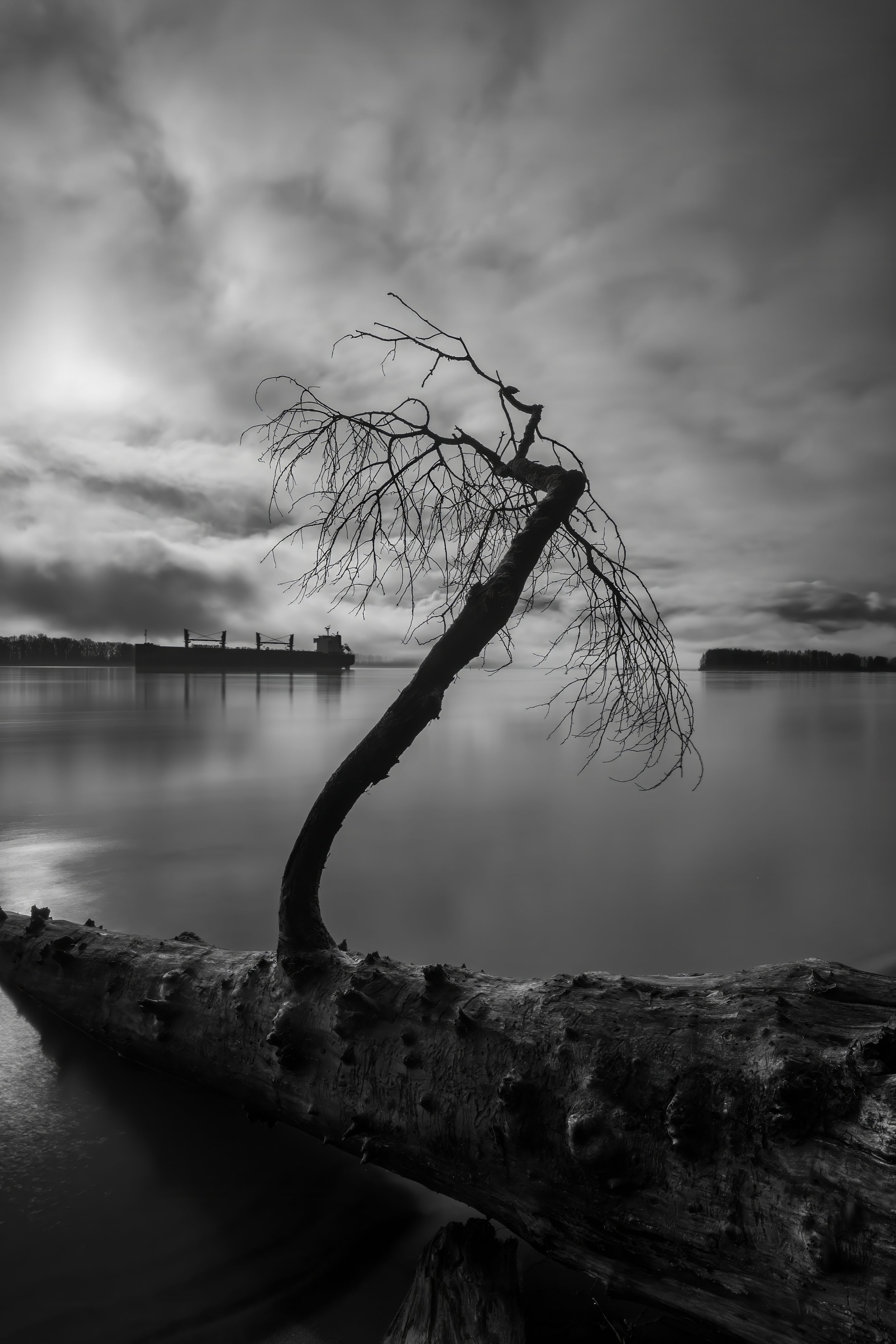
This photograph was made on the banks of the Columbia River, not at a celebrated viewpoint, but in a place most people would simply walk past. A fallen tree, a quiet stretch of water, an overcast morning. Nothing particularly remarkable at first glance.

What caught my attention was not the location itself, but the relationship between the elements within the frame.

The composition began with the fallen trunk stretching across the foreground. It provides weight and stability, a visual foundation from which the image grows. Rising from that trunk is the small, bent tree. Its shape immediately suggested a gesture—a bow, a reaching arm, perhaps even a question. The curve creates movement, drawing the eye upward and outward into the scene.

The branches become increasingly delicate as they extend into the sky. Against the soft tones of the clouds they create a natural calligraphy, a contrast between fragility and strength. The heavy trunk anchors the image while the finer branches introduce tension and elegance.

The distant ship was important, but only after the tree had established itself. Had the vessel been the subject, the image would have been about industry and scale. Instead, it becomes a secondary element—a counterpoint. Its rigid geometry contrasts with the organic shape of the tree, while its position balances the frame without dominating it.

The long exposure simplifies the river into a quiet plane of tone. By removing texture from the water, attention remains on shape and form. The eye is not distracted by detail; it moves naturally between the tree, the ship, and the sky.

When I look at the image now, I’m reminded that composition often matters more than location. Great photographs are rarely discovered by accident, but they are frequently found in unexpected places. The challenge is not travelling further or finding a more dramatic landscape. The challenge is slowing down enough to see what is already there.

Sometimes all it takes is a fallen tree on the edge of a river and the willingness to look a little longer than everyone else.